spDDB
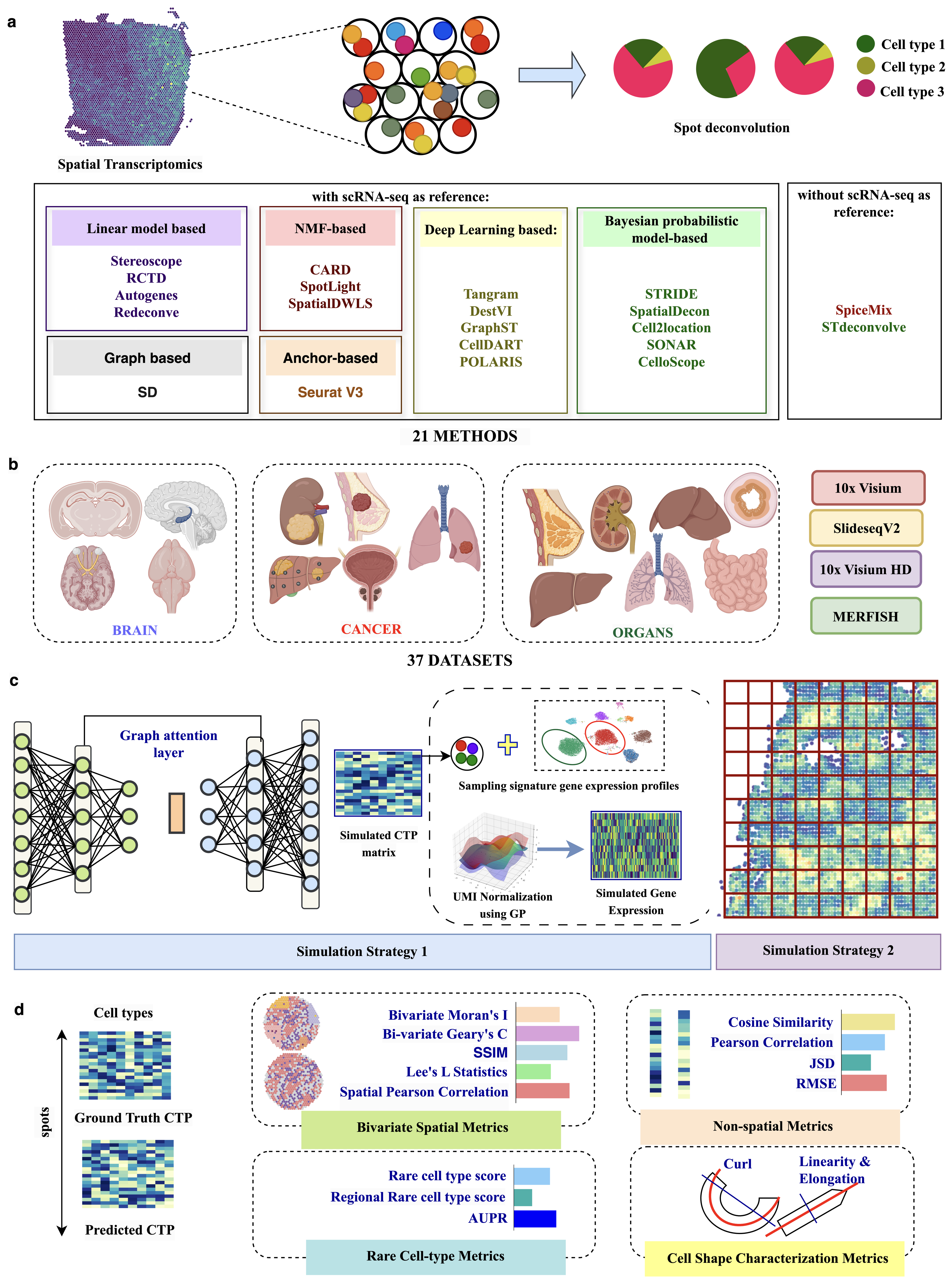
A Comprehensive Benchmarking of Spatial Deconvolution and Domain Detection Methods across Diverse Tissues and Spatial Transcriptomic Technologies.
Paper: https://doi.org/10.64898/2026.05.11.724248
Installation
Clone the repository at https://github.com/Zafar-Lab/spDDB_datasets.github.io and create the required conda environments using the environment files provided in ./Environments/.
We recommend using the stable main branch.
git clone https://github.com/Zafar-Lab/spDDB.git
cd spDDB/Environments

conda env create -f SynthST.yml
conda activate SynthST

conda env create -f method_name.yml
conda activate method_name
What Computational Tasks Can spDDB Be Used For?
spDDB provides a comprehensive framework for:
Benchmarking spatial deconvolution methods.
Benchmarking spatial domain detection methods.
Evaluating spatial transcriptomics methods using a rich collection of metrics, including:
Bivariate spatial metrics
Cell-type shape characterization metrics
Rare cell-type metrics
Simulating synthetic spatial transcriptomics datasets and cell-type proportions using
SynthST.Accessing a diverse repository of spatial transcriptomics datasets spanning multiple tissues, species, and technologies.
spDDB Dataset Repository
Synthetic datasets and benchmarking resources are available at:
Contributing
We welcome bug reports, enhancement requests, and general questions through GitHub Issues.
For substantial contributions:
Fork the repository.
Create a feature branch.
Commit your changes with clear commit messages.
Submit a pull request for review.
Citation
If you use spDDB in your research, please cite:
Ajita Shree, Aditya V*, Tanush Kumar*, and Hamim Zafar.
A Comprehensive Benchmarking of Spatial Deconvolution and Domain Detection Methods across Diverse Tissues and Spatial Transcriptomic Technologies.
* Equal contribution.
Tutorials
- SynthST for generation of synthetic cell type proportions - DLPFC 151508
- SynthST for generation of synthetic spatial gene expression - DLPFC 151508
- Generation of datasets using Simulation Strategy 2 - MERFISH Lung Cancer
- spDDB’s Bi-variate Spatial and Non-spatial evaluation metrics - DLPFC 151508
- Identification of Regionally Rare and Rare cell types - DLPFC 151508
- Identification of High Curl, High Elongation, Low Elongation, High Linearity and Low Linearity cell types - DLPFC 151508
- spDDB’s Domain Detection evaluation metrics - DLPFC 151508